
Paris attracts nearly 30 million visitors annually, making it one of the world’s most visited cities, yet first-time travelers often struggle to balance iconic landmarks with authentic experiences within limited time. A five-day visit provides enough time to see the essential monuments while avoiding the exhausting pace of rushed sightseeing that leaves visitors overwhelmed rather than inspired. This itinerary prioritizes strategic location sequencing, neighborhood exploration, and practical logistics to help first-time visitors experience Paris efficiently.
Understanding Paris’s Geographic Layout and Transportation
Paris is organized into 20 administrative districts called arrondissements, arranged in a spiral pattern from the center outward. The city’s geography divides naturally into the Left Bank (Rive Gauche) and Right Bank (Rive Droite), separated by the Seine River. Understanding this layout prevents wasted travel time and helps visitors navigate the city’s distinct neighborhoods, each with its own character, dining options, and attractions. The Métro system, opened in 1900, comprises 16 lines and 300 stations, making it the fastest way to move between districts.
First-time visitors should purchase a carnet (a booklet of 10 Métro tickets) or a multi-day pass rather than buying individual tickets. A five-day visitor can use the Métro to reach nearly every major attraction within 10-15 minutes from any starting point, though walking between adjacent neighborhoods often reveals hidden cafés, galleries, and street markets that tours miss entirely.
Days 1-2: The Classic Right Bank and Central Monuments
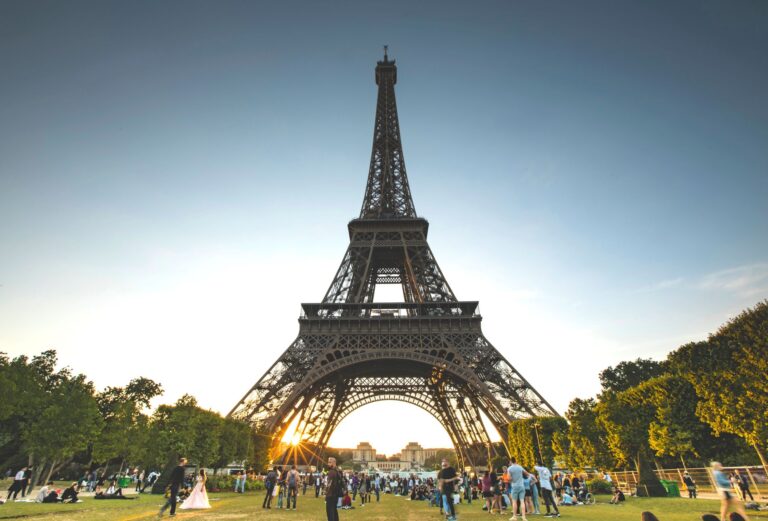
Begin your Paris experience in the 1st and 8th arrondissements, home to the city’s most recognizable landmarks. Day one should include the Eiffel Tower, built for the 1889 World’s Fair and originally intended to be temporary. Most first-timers either climb the stairs (674 steps to the second floor) or take the elevator to the top, which provides unobstructed views across Paris. Arriving early—before 9 a.m.—significantly reduces wait times, and purchasing tickets online in advance eliminates queueing at the ticket office.
After the Eiffel Tower, walk through the Trocadéro area for a different perspective of the structure, then head to the Arc de Triomphe, completed in 1836 to commemorate Napoleon’s military victories. The Champs-Élysées, the avenue connecting these two monuments, stretches 1.9 kilometers and serves as Paris’s primary shopping district. On day two, visit the Louvre Museum, the world’s largest art museum by floor space, housing 38,000 objects including the Mona Lisa and Venus de Milo. The Louvre’s glass pyramid entrance, designed by I.M. Pei and opened in 1989, initially faced criticism but now symbolizes the museum’s blend of classical and contemporary architecture.
Days 2-3: The Historic Islands and Left Bank
The Île de la Cité and Sainte-Chapelle occupy the geographic and spiritual heart of medieval Paris. Sainte-Chapelle, constructed between 1241 and 1248 by King Louis IX, contains 15 stained-glass windows depicting biblical scenes and covers 6,514 square meters. The chapel’s interior light transforms throughout the day as sunlight passes through the glass, creating an experience that differs markedly from morning to afternoon visits. Nearby, Notre-Dame Cathedral dominates the island’s eastern end, though visitors should verify access status as restoration work progresses following the April 2019 fire.
Cross to the Left Bank and explore the Latin Quarter, historically the city’s intellectual center and home to the Sorbonne University, established in 1257. Wander through narrow streets lined with independent bookstores, particularly along Rue de la Bûcherie and around Shakespeare and Company bookstore, a legendary English-language shop opened in its current location in 1951. The Panthéon, a neoclassical structure completed in 1790, houses the remains of French luminaries including Voltaire and Rousseau, offering architectural grandeur and panoramic city views from its dome.
Day 3-4: Museums, Markets, and Neighborhood Immersion
Dedicate portions of days three and four to the Musée d’Orsay, housed in a former railway station built in 1900 and converted to a museum in 1986. The collection emphasizes Impressionist and Post-Impressionist works, including paintings by Monet, Renoir, and Van Gogh. Unlike the Louvre’s encyclopedic scope, the Musée d’Orsay focuses deeply on a specific period, making it manageable for visitors with limited museum time. The building itself, with its ornate clock faces and Belle Époque architecture, provides as much visual interest as the artwork.
Spend a morning exploring the Marais district in the 4th arrondissement, a neighborhood combining medieval streets, Jewish heritage sites, and contemporary art galleries. Visit the Place des Vosges, Paris’s oldest planned square completed in 1612, where arcaded galleries house boutiques and the Victor Hugo House Museum. Explore local markets like Marché Bastille (Thursday and Sunday mornings), where vendors sell produce, cheese, flowers, and prepared foods at prices lower than tourist-area restaurants. Lunch at a neighborhood bistro rather than a famous establishment offers better value and more authentic interactions with Parisians.
Day 4-5: Montmartre and Final Explorations
Montmartre, the 18th arrondissement hilltop neighborhood, contrasts sharply with central Paris through its bohemian character and village-like atmosphere despite urban density. The Basilica of Sacré-Cœur, completed in 1919 and built with white travertine stone that self-cleans in rain, dominates the skyline and offers views extending 30 kilometers on clear days. The basilica sits atop Butte Montmartre, requiring either climbing 222 steps or taking the funicular railway, a cable car system that has operated since 1900.
Explore the narrow streets around Rue Lepic and Rue des Trois Frères, where cafés and galleries occupy spaces that attracted artists like Picasso and Van Gogh in the late 1800s. The Moulin Rouge cabaret, established in 1889 and still operating, represents Belle Époque entertainment, though modern shows target tourists rather than locals. On your final day, revisit a favorite neighborhood, shop for souvenirs at smaller boutiques rather than chain stores, or spend time in a park like Jardin du Luxembourg, where locals gather on chairs arranged throughout the 24.7-hectare space.
Häufig gestellte Fragen
How much does a five-day Paris trip cost for budget travelers?
Budget travelers can expect to spend €80-120 daily on accommodation in hostels or budget hotels outside central arrondissements, plus €30-50 on food (shopping at markets and eating lunch as the main meal), €15-20 on Métro passes, and €10-30 on museum entries. Total costs typically range from €600-1000 per person for five days excluding international flights.
Which museums require advance booking?
The Louvre and Musée d’Orsay accept both advance online bookings and same-day purchases, though booking ahead eliminates entrance-line wait times. Most other museums have minimal queues and accept walk-in visitors, though visiting during weekday mornings ensures shorter waits than weekend afternoons.
Is five days enough to see Paris properly?
Five days allows first-time visitors to experience major landmarks, key museums, and neighborhood character without exhaustion. Visitors can return for deeper exploration of specific periods, artists, or neighborhoods on subsequent trips, as Paris rewards multiple visits with discoveries that initial itineraries miss.
This five-day framework balances Paris’s essential attractions with neighborhood exploration and practical pacing that prevents visitor fatigue. First-time travelers who follow this geographic sequencing, use the Métro strategically, and allocate time for unplanned discoveries leave Paris with both the iconic memories and authentic experiences that distinguish great trips from merely completed checklists.
